Table of contentsJump to a section26 sections
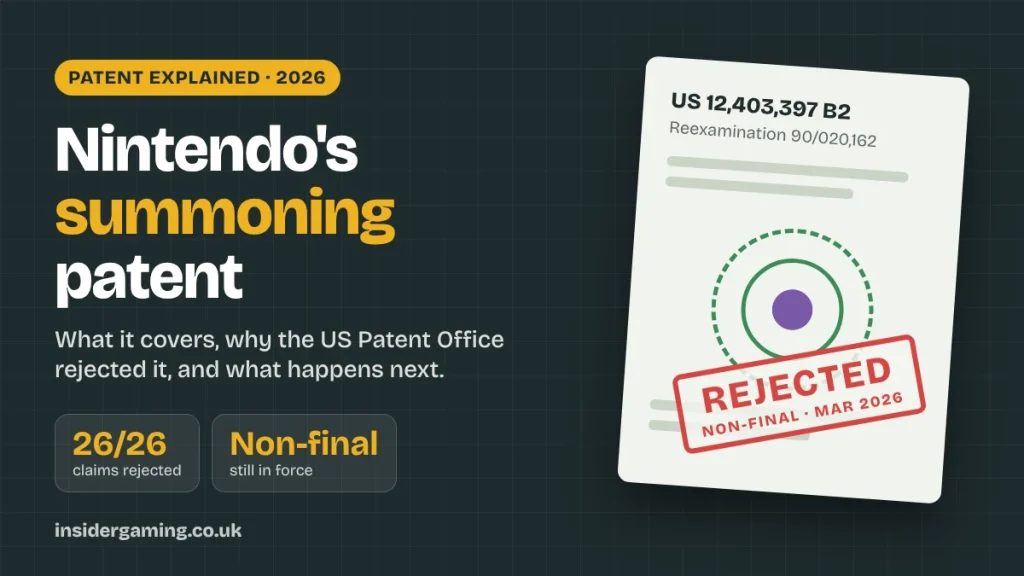
Quick answer: “Nintendo’s summoning patent” is US Patent 12,403,397, granted to Nintendo and The Pokémon Company on 2 September 2025. It covers a specific combination of mechanics: you summon a companion character, it fights enemies in a turn-based command battle, and a separate button sends it to battle automatically. It does not cover summoning in general. In November 2025 the head of the US Patent Office ordered a rare re-check of the patent, and on 25 March 2026 an examiner rejected all 26 of its claims as obvious. That rejection is not final. As of 10 October 2026, we have found no public report of a final decision.
Key takeaways
- The patent is narrow. A game would need every element of a claim to infringe it, not just “a summon”.
- It describes a system very close to the “Let’s Go” auto-battle in Pokémon Scarlet and Violet, which lets your Pokémon fight wild Pokémon without commands.
- The USPTO says older patents from Konami, Bandai Namco and Nintendo itself already made the idea obvious.
- The patent is still legally in force while the reexamination runs. Nintendo’s deadline to reply ran out on 25 September 2026 at the latest, and no reply has been reported publicly.
- Japan has refused two related Nintendo applications, one after an examiner cited a 2013 Pokémon fan game video.
- It is not one of the patents in Nintendo’s Palworld lawsuit, which is being heard in Tokyo under Japanese patents.
- A US patent has no legal effect in the UK on its own.
What is the Nintendo summoning patent?
The patent has a dull official title: “Storage medium, information processing system, information processing apparatus, and game processing method”. Its number is US 12,403,397 B2. Some reports have printed it as 12,433,397, which is a different patent, so check the number if you look it up yourself.
| Detail | What the record shows |
|---|---|
| Patent number | US 12,403,397 B2 |
| Owners | Nintendo Co., Ltd. and The Pokémon Company |
| Named inventor | Shigeru Ohmori (a long-time Pokémon game director) |
| US application | 18/116,023, filed 1 March 2023 |
| Japanese priority date | 16 August 2022 |
| Granted | 2 September 2025 |
| Number of claims | 26 |
| Reexamination | Ordered by the USPTO Director on 3 November 2025 (control number 90/020,162) |
| Earlier publication | US 2024/0058701 A1, published 22 February 2024 |
| Current status | All 26 claims rejected in a non-final Office action dated 25 March 2026. No final decision reported as of 10 October 2026. |
Two things made gamers angry when the grant was reported in September 2025. First, the patent was approved without any pushback during its original examination. Patent attorney Kirk Sigmon told Techdirt the reasons for allowance “don’t give us even a hint of why it was allowed”. Second, the headlines made it sound as if Nintendo now “owned summoning”, a mechanic that has existed in role-playing games since at least the early Final Fantasy games.
The examiner’s stated reason for allowing it was the two battle types. The patent describes a battle where the player controls the action with commands (the “first mode”) and a simpler automatic battle (the “second mode”), both started from the same summoned companion. That pairing is what the original examiner thought was new.
What the patent actually covers
Patents are judged by their claims, not by headlines. The patent’s drawings and description use a familiar example. The player walks around an open field and throws a ball. What happens next depends on where the ball lands:
- Ball thrown at an enemy: the companion comes out and a turn-based “command battle” begins. The player picks commands such as attack, capture or run.
- Ball thrown with no enemy nearby: the companion appears and follows the player around the field.
- A separate button aimed at an enemy: the companion fights it automatically. The patent says the victory reward here “is set so as to be less than” in a command battle. If the companion loses, its hit points are set to a fixed value (1 in the patent’s example) rather than 0. If another enemy is within range when a fight ends, a new automatic battle starts.
The patent states plainly that “the enemy character cannot be captured in the automatic battle”. If that sounds like Pokémon Scarlet and Violet, it is meant to. The “Let’s Go” feature in those games sends your lead Pokémon out to auto-battle wild Pokémon, while throwing a Poké Ball at one starts a normal turn-based battle.
Try it: would a game tick every box?
This is the part most coverage skips. In patent law, a product only infringes a claim if it does everything the claim describes. Lawyers call this the all-elements rule. Tick the boxes below for any game you like and see how quickly a “summoning” game stops matching.
The checker simplifies the main claim into five elements. Real claims contain more detailed wording, and the dependent claims add extra conditions. For a real product decision, speak to a patent attorney.
Quick quiz: myth or fact?
Plenty of headlines about this patent were misleading. Test yourself before reading the myth-busting below.
Myths about Nintendo’s summoning patent
Myth: Nintendo now owns summoning in video games.
No. The claims cover one specific combination of steps. A game where you summon a creature that simply fights, like a classic Final Fantasy summon, is missing most of the elements. In patent law it is the full combination that is protected, not the general idea. That said, critics worried the wording could be read widely enough to worry studios behind monster-collecting and party-based games, which is why the reexamination matters.
Myth: The US Patent Office has cancelled the patent.
Not yet. Several sites ran headlines saying the patent was “revoked” or “torn up”. What actually happened on 25 March 2026 was a non-final rejection inside a reexamination. The patent stays in force until the process ends with a certificate that cancels, confirms or amends the claims.
Myth: This is the patent Nintendo is using to sue Palworld.
No. The Palworld case is in the Tokyo District Court and is based on three Japanese patents (JP 7545191, JP 7493117 and JP 7528390) about capturing creatures by throwing an item and riding or gliding on them. The US summoning patent is a separate right in a different country. The two stories are linked by subject, not by the courtroom.
Myth: The patent stops UK developers making games like this.
A US patent only applies to activity in the United States. Protection in the UK would need a separate UK patent or a European patent that covers the UK. A UK studio selling a game on US storefronts could still have to think about US patents, which is why the reexamination outcome matters to developers here too. With UK studios already under pressure, as we covered in why the UK games industry is misunderstood, legal uncertainty is the last thing small teams need.
Timeline: from filing to rejection
- 16 August 2022Nintendo files the Japanese application the US patent claims priority from.
- November 2022Pokémon Scarlet and Violet launch on Switch, including the “Let’s Go” auto-battle.
- 1 March 2023US application 18/116,023 is filed.
- 19 September 2024Nintendo and The Pokémon Company announce a patent lawsuit against Palworld developer Pocketpair in Tokyo, under Japanese patents.
- 2 September 2025US Patent 12,403,397 is granted with no rejections during examination. Patent attorney Kirk Sigmon calls it “an embarrassing failure of the US patent system”.
- 22 October 2025In Japan, the patent office issues a (non-final) refusal notice for a Nintendo monster-capture application linked to the Palworld patents.
- 3 November 2025USPTO Director John Squires personally orders an ex parte reexamination, citing a 2002 Konami filing and a 2020 Nintendo filing. Games Fray reported it may be the first such order in more than a decade, with the last confirmed one in 2012.
- 25 March 2026The examiner issues a 104-page non-final Office action rejecting all 26 claims as obvious. It becomes public news around 1 April.
- 25 June 2026Nintendo’s deadline to reply without paying extension fees.
- 7 July 2026Japan refuses a separate Nintendo touchscreen monster-capture application (2026-019762), citing a 2013 fan game video.
- 25 September 2026Latest possible reply deadline with paid extensions.
- 1 October 2026The Palworld case in Tokyo was scheduled to hear evidence. We have not seen a published outcome.
- 10 October 2026 (today)No public report of Nintendo’s response, a final rejection or a reexamination certificate. The file can be checked in USPTO Patent Center under control number 90/020,162.
- 9 November 2026 (expected)The Tokyo District Court is expected to share its view in the Palworld case.
Interactive: where is the patent now?
Reexamination has several stages and the news only covered two of them. Tap through the tracker to see what has happened and what can still happen.
Why the USPTO rejected all 26 claims
A patent can be refused if the invention would have been “obvious” to a skilled person who knew the earlier work, called prior art. The March 2026 action, under 35 U.S.C. § 103, combines older documents to show that each claim was already obvious. Each claim was rejected on two alternative theories, and either one would be enough on its own:
- Theory 1: Taura (Nintendo) + Yabe (Konami), with Shimomoto (Bandai Namco) added for some claims.
- Theory 2: Taura (Nintendo) + Motokura (Nintendo), with Shimomoto added for some claims.
Eighteen claims (1, 2, 5 to 7, 10 to 14, 17 to 19 and 22 to 26) fell to two-document combinations. Eight claims (3, 4, 8, 9, 15, 16, 20 and 21) needed three. Because Taura sits in both theories, Nintendo’s own earlier filing is part of every one of the 26 rejections.
| Prior art | Owner | Filed / published | Role in the rejection |
|---|---|---|---|
| Taura, US 2020/0254335 A1 | Nintendo | Dec 2019 / Aug 2020 | The main reference in all 26 rejections. Cited by the Director when ordering the re-check. |
| Yabe, US 2002/0119811 A1 | Konami | Jan 2002 / Aug 2002 | Theory 1. Also cited by the Director. Games Fray says it teaches battling in a manual mode and a simpler automatic mode, more than 20 years before Nintendo’s filing. |
| Motokura, US 2022/0062760 A1 | Nintendo | Aug 2020 / Mar 2022 | Theory 2. |
| Shimomoto, US 2020/0086216 A1 | Bandai Namco | Sep 2019 / Mar 2020 | Added in both theories for eight dependent claims. |
Prior art is usually named after its first inventor. Publication numbers and dates as reported by Games Fray and patent law firm MBHB.
The surprising part is that the Director cited these documents himself. Normally, a reexamination is requested by someone who wants a patent knocked down, often a company that has been sued. Here, the head of the USPTO started it, and no outside company was involved. The order initially focused on the four independent claims (1, 13, 25 and 26). Nintendo let the optional patent owner statement deadline pass before the examiner’s March decision.
What “non-final” means, and what happens next
A non-final rejection is the examiner’s opening position. According to patent law firm MBHB, Nintendo’s reply was due by 25 June 2026, or by 25 September 2026 at the latest if it paid extension fees. Its options were:
- Argue the examiner is wrong. For example, that the older documents don’t teach the two-mode battle system together.
- Amend the claims. Narrow them so they no longer overlap with the prior art. In reexamination, claims can be narrowed but never broadened.
- Interview the examiner to discuss possible amendments.
- Say nothing. The rejected claims would then be cancelled when the reexamination ends.
After Nintendo’s response, the examiner can allow the claims or issue a final rejection. A final rejection can be appealed to the Patent Trial and Appeal Board, and after that to the Court of Appeals for the Federal Circuit. That route can take years. The process ends with a reexamination certificate saying which claims survive, if any.
What we couldn’t confirm: Even the latest reply deadline (25 September 2026) has now passed. MBHB partner Andrew Velzen wrote in April that he expected Nintendo to reply with amendments and/or arguments. But we searched news and legal coverage up to 10 October 2026 and found no public report of what Nintendo filed, or of a further Office action. If you see a headline claiming the patent is “dead”, check whether it links to a final action or a certificate. We will update this article when the record changes.
How this connects to Palworld
The summoning patent isn’t part of the Palworld case, but it changed the conversation around it. Here is where that case stands, based on public reporting:
- Nintendo and The Pokémon Company sued Pocketpair in the Tokyo District Court in September 2024, seeking an injunction and 5 million yen each plus late-payment interest.
- Pocketpair changed Palworld in two patches. Version 0.3.11 (November 2024) stopped Pals being summoned by throwing a Pal Sphere; they now appear beside the player. Version 0.5.5 (May 2025) replaced gliding while holding a Pal with a separate glider item.
- Nintendo reworded one of its Japanese patents during the case in 2025, and in November 2025 narrowed its claims to older versions of Palworld from before those patches. IP analyst Florian Mueller estimated the most Nintendo could now recover is around 5 million yen (about $30,000).
- The court was scheduled to hear evidence on 1 October 2026 and is expected to share its view on 9 November 2026. We haven’t seen a published outcome at the time of writing.
Analysts said the US rejection doesn’t decide the Japanese case, but it makes Nintendo’s wider patent strategy look weaker. GamesRadar reported an IP expert saying the reexamination “further” undermined Nintendo’s position.
Japan has pushed back too
The US is not the only patent office to say no to Nintendo’s creature-battle filings. None of these decisions cancels the patents used against Palworld, but they show examiners taking prior art from real games seriously.
| Japanese application | Decision | What the examiner relied on |
|---|---|---|
| 2024-031879 (monster capture). Part of the same family as two patents asserted against Palworld. | Notice of refusal, 22 October 2025. Non-final: Nintendo could reply or amend. | Lack of inventive step. Prior art sent in by an unnamed third party in April 2025, including ARK: Survival Evolved, Monster Hunter 4, Craftopia, Kantai Collection and Pokémon GO. |
| 2026-019762 (touchscreen monster capture), filed by Nintendo and The Pokémon Company | Refused on 7 July 2026, after a first refusal notice in April. Nintendo had three months to request an appeal trial. | A 2013 YouTube video of the fan-made “Pokémon Generations” indie game, plus material on touchscreen controls and mobile versions of PC games. |
The second case has a twist. Nintendo argued the fan game video shouldn’t count as prior art because the fan game itself allegedly infringed Pokémon copyrights. The Japan Patent Office disagreed: publicly available material still counts as prior art, even if making it may have infringed copyright. Some claims in that application drew no objection at that stage, so a narrower version could still survive.
What it means for players and developers
If you’re a player
Nothing changes for the games you own, whether you play on a Switch or elsewhere (if you’re a Switch owner wondering about other big games, see can you play Roblox on Nintendo Switch?). No game has been withdrawn because of this patent, and nobody has been sued over it as far as public records show. The long-term worry is a “chilling effect”: smaller studios dropping ideas because they fear a lawsuit, even when the patent is narrow or weak. Players have had real influence on publishers before, as the Destiny 3 petition showed, and the public reaction to this patent is part of why it got so much scrutiny.
If you’re a developer
- Read the claims, not the headlines. Use the checker above as a quick guide to the main elements, then get advice for anything you plan to ship.
- Watch the reexamination. If the claims are cancelled, the risk disappears. If they’re amended, the new wording will be narrower than today’s.
- Keep records of your design history. Patent lawyers writing about this case have pointed out that dated design documents and builds can help if prior use ever becomes an issue.
- Remember where you sell. A US patent matters for US sales. UK sales would need a UK-effective patent to be at risk.
What the experts said
- Kirk Sigmon, patent attorney, told Techdirt in September 2025 that Nintendo’s newly granted patents “have been an embarrassing failure of the US patent system”. He later told PC Gamer the claims “were in no way allowable”.
- Florian Mueller, IP analyst at Games Fray, called the Director’s reexamination order a “huge blow” to Nintendo and said Nintendo “should never” have received the patent.
- Don McGowan, former chief legal officer at The Pokémon Company, told Eurogamer: “I wish Nintendo and Pokémon good luck when the first other developer just entirely ignores this patent.”
- Andrew Velzen, partner at US law firm MBHB, wrote after the rejection that he expected Nintendo to fight back with amendments and/or arguments.
Our take: The summoning patent is less scary than the headlines suggested and more embarrassing for the patent system than Nintendo will like. It was always narrow. Now its claims have been rejected by the office that granted them, using Nintendo’s own older filings as part of the reason. Until a final decision or certificate is published, the honest status is “in force but under serious threat”. For more on how outside forces shape the games we get to play, read our explainer on why the UK games industry is misunderstood.
Frequently asked questions
Has Nintendo patented summoning?
Not summoning in general. US Patent 12,403,397 covers a specific system: summoning a companion that can join a command battle or be sent to fight automatically, with different results depending on whether an enemy is present. A game needs every element of a claim to infringe it.
What is the patent number?
US 12,403,397 B2. The reexamination has control number 90/020,162.
Is Nintendo’s summoning patent still valid?
Yes, for now. All 26 claims were rejected as obvious in a non-final action on 25 March 2026, but the patent remains in force until the reexamination ends with a certificate. Nintendo’s latest reply deadline was 25 September 2026. As of 10 October 2026 we have found no public report of its reply or a further decision.
Why was the patent rejected?
The examiner found every claim obvious in light of older patent filings: Konami’s “Yabe” (2002), Bandai Namco’s “Shimomoto” (2020) and two of Nintendo’s own, “Taura” (2020) and “Motokura” (2022). Taura is used in every rejection.
Is this patent part of the Palworld lawsuit?
No. The Palworld case is in Japan and uses three Japanese patents. The US summoning patent is a separate right.
Does the patent affect games sold in the UK?
Not directly. A US patent only covers activity in the United States. A UK studio selling in the US would need to consider it there.
Which Pokémon game uses this mechanic?
The system described closely matches the “Let’s Go” auto-battle in Pokémon Scarlet and Violet (2022), where your lead Pokémon can fight wild Pokémon automatically.
What happens next?
If Nintendo replied by its deadline, the examiner will accept the arguments or amendments or issue a final rejection, which can be appealed to the Patent Trial and Appeal Board and then the Federal Circuit. If Nintendo didn’t reply, the rejected claims will be cancelled when the reexamination certificate is issued.
Has Japan rejected Nintendo’s patents too?
Japan has refused two related Nintendo applications: a monster-capture application (2024-031879, refusal notice October 2025) and a touchscreen capture application (2026-019762, refused July 2026 after the examiner cited a 2013 fan game video). The three patents used against Palworld remain in force.
How we made this article
Cody researched this story using the patent record on Google Patents, patent law firm MBHB’s analysis of the reexamination, the EU Intellectual Property Helpdesk, and specialist coverage from Games Fray, Techdirt, Nintendo Life, GamesRadar and Engadget. We compared what the top-ranking pages already covered and added what they left out: a plain-English breakdown of the claim, three interactive tools, the reply deadlines, the full prior-art breakdown with publication numbers, both Japanese refusals, and a UK angle. We used AI tools to help organise research and draft parts of the text; every fact, date and quote was checked by our editors against the sources listed below. Read more in our editorial guidelines or about Insider Gaming.
Sources
- Games Fray: Director orders reexamination
- Games Fray: Examiner rejects all claims (non-final)
- Nintendo Life: Patent rejected by US Patent Office
- GamesRadar: IP expert on the reexamination
- Engadget: Patent being reexamined
- Google Patents: US 12,403,397 B2 (full text)
- MBHB: Pokémon reexam receives first action from USPTO
- Techdirt: Kirk Sigmon on the newly granted patents
- EU IP Helpdesk: JPO refuses touchscreen monster-capture application
- Games Fray: JPO rejects application 2024-031879
- USPTO Patent Center (search control number 90/020,162)
More from Insider Gaming: latest gaming news, features and how to redeem codes on Roblox.
Reader Discussion (0)
Community Moderated