Table of contentsJump to a section27 sections
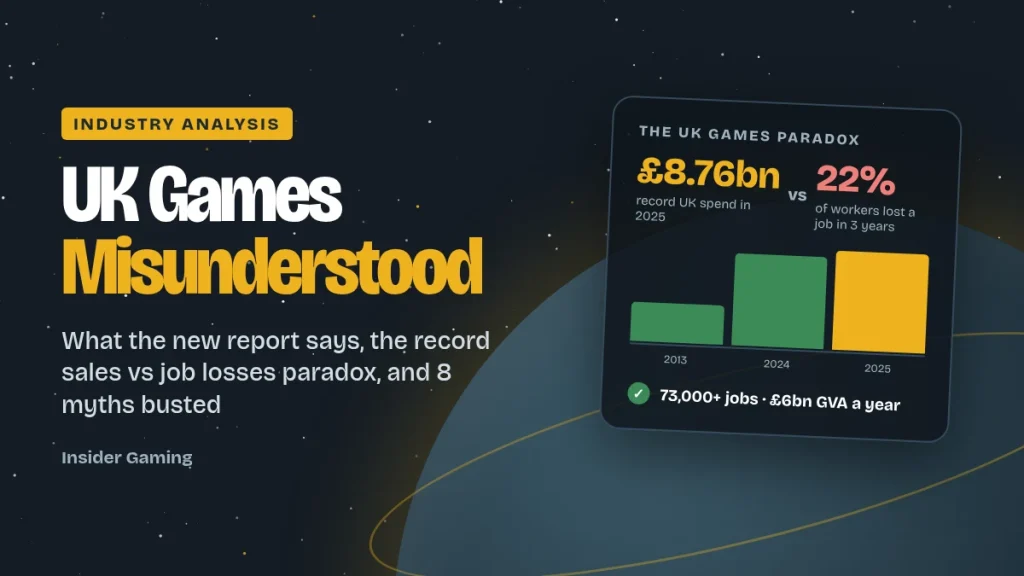
Quick answer: In May 2026, the UK games trade body Ukie and the charity OKRE published a report arguing that the UK games industry is “fundamentally misunderstood”. Their point is that decision-makers judge games almost entirely on sales figures, while their wider effects on health, education, culture and other industries are barely measured. That partial picture shapes how government, investors and the public treat the sector. It’s also why the industry can post record consumer spending (£8.76 billion in 2025) while thousands of UK developers lose their jobs.
Updated 7 October 2026. Figures come from Ukie, OKRE and the other sources named in this article.
Key takeaways
- Ukie and OKRE say decisions about UK games are based on a “limited, partial view” because almost all reliable data is about sales.
- Their May 2026 report proposes one framework to measure games’ social, cultural and economic impact side by side.
- The UK market hit a record £8.76 billion in 2025, yet more than one in five UK games workers surveyed had lost a job in the previous three years.
- The report is a starting point. Whether it changes anything depends on government, studios and researchers using it.
Quick quiz: how well do you know UK games?
Before we dig into the report, test yourself. Every answer is based on the latest data, and all eight are explained further down.
What did the report actually say?
The report is called Building a Unified Framework for UK Video Games Impacts. It was produced by OKRE (a charity that researches the impact of entertainment) and Ukie (the trade body for UK games), with support from the BFI National Lottery Innovation Challenge Fund. It’s free to read at videogamesimpacts.co.uk.
Its central argument is simple: games now reach into almost every part of British life, but research into their full impact is still at an early stage and scattered across different studies. As a result, the report says, decisions about the sector are based on a limited, partial view. That affects everything from government policy to investment and partnerships.
To fix this, the report proposes a single framework that any researcher or policymaker could use. Its key ideas are:
- A wider definition of the “games sector”. As well as studios and publishers, it includes service providers, funders, regulators, researchers, educators and organisations influenced by games, mapped in an interactive supply chain diagram.
- Three “anchor points” that drive all of games’ impacts: making games, playing games, and third parties using games and their technology for other purposes (for example, in healthcare or defence).
- Measuring social and economic impact side by side, using a “Theory of Change” model that traces how a games activity leads to a real-world outcome.
- Three initial social impact areas: Culture & Society, Health & Wellbeing, and Education & Learning.
- A neutral approach. The framework doesn’t label impacts as good or bad. Ukie CEO Nick Poole summed it up by saying games are neither inherently good nor bad, but a cultural phenomenon.
The report calls on industry, government and academia to work together to fill the research gaps, and Ukie and OKRE have launched a survey asking developers and publishers how they measure their own impact.
What most coverage missed: This isn’t the first attempt. In May 2023, the UK government (DCMS) published its own Video Games Research Framework to encourage independent research into games. The new report goes further by defining the whole sector, linking social and economic impacts, and giving researchers a shared model to build on. The fact that a second framework was needed three years later shows how slowly the evidence base is growing.
The paradox at the heart of the problem: record sales, lost jobs
If you only read the headline numbers, the UK games industry looks like it’s booming:
Explore the numbers yourself: switch between the market’s growth and its 2025 breakdown.
In 2025, UK consumers spent £6.03 billion on game software (up 7%), £2.17 billion on hardware (up 3%, helped by the Nintendo Switch 2 launch), and £566 million on “game culture” such as game-based films and TV (up 42%).
But the people who make games tell a very different story:
- Ukie’s own workforce survey, covering 1,610 UK games professionals, found that 22% had lost a job in the previous three years through redundancy, studio closure or contracts ending.
- People who were out of work for over a year were increasingly likely to leave games altogether.
- The game workers’ union IWGB estimated in July that over 9,000 game workers had been laid off since the start of 2026, and set up a “Redundancies Taskforce” in response.
- This month, staff at Ninja Theory, the Cambridge studio behind Hellblade, began reporting that their roles are at risk, after Xbox said two deals to sell the studio fell through and it would consult on a proposed closure.
How can both things be true? Consumer spending measures what UK players buy, including games made abroad. Jobs depend on whether studios can secure funding, publishing deals and investment. When decision-makers only look at the sales line, they see a healthy industry and miss the pressure on the people and studios behind it. That’s exactly the kind of “partial view” the report warns about.
8 myths about the UK games industry, and the facts
Myth 1: Games are just for kids
Fact: 65% of UK adults play video games, as well as 88% of children. That includes everything from console blockbusters to daily word puzzles like Blossom and Reunion.
Myth 2: The only thing that matters is how much money games make
Fact: This is the report’s main target. Games influence healthcare, education, fashion, music, film and TV, and games culture spills into everyday life, from game-based films to adults-only games bars like Fairgame. Ukie also estimates games create a further £1.3 billion in spillover benefits for other parts of the economy.
Myth 3: A record-breaking market means jobs are safe
Fact: As above, record consumer spending has come alongside years of redundancies and closures. More spending doesn’t automatically mean more UK jobs.
Myth 4: It’s all happening in London
Fact: Around 55% of UK studio roles are outside London and the South East. There are major clusters from Dundee and Edinburgh to Leamington Spa, Guildford, Manchester and Cambridge.
Myth 5: The UK is a small player in games
Fact: The UK is the world’s 5th-largest games market, and around 20% of games sold in the UK are developed here, compared with a European average of 8%. Around 26,000 people work directly in UK games development, versus a European average of about 2,000 per country. UK studios are behind some of the world’s best-known series, including Grand Theft Auto, Tomb Raider, Forza Horizon and Football Manager.
Myth 6: Games are either good or bad for you
Fact: The report deliberately refuses to take sides. Its framework records impacts without labelling them positive or negative, so that policy can be based on evidence rather than moral panic. The UK has a long history of the opposite: in 1997, for example, the BBFC initially refused to classify the violent driving game Carmageddon, before the original version was approved after a 10-month appeal.
Myth 7: Anyone who’s talented can get a job in games
Fact: Research by the non-profit Into Games, reported by the BBC, found that location, access to money, “cultural capital” and a lack of industry contacts hold back people from lower-income backgrounds. Combined with recent job losses, that makes the industry harder to break into than many people assume.
Myth 8: Games don’t need government support
Fact: Policy shapes the industry significantly. UK studios can claim the Video Games Expenditure Credit (VGEC), currently 34% on qualifying costs, and the government’s Games Growth Package included £28.5 million for the UK Games Fund, which supports small studios. Ukie, TIGA and the UK Video Games Council are lobbying for an enhanced VGEC, arguing it would create nearly 6,000 jobs, but no decision had been announced as of mid-2026.
Why it matters if the industry is misunderstood
- Funding and investment: Investors and government funders can only back what they can measure. If games’ wider value isn’t captured, it’s harder to make the case for support.
- Policy: Tax credits, skills funding and regulation are all decided using whatever evidence exists. Weak evidence means weaker policy.
- Public perception: Coverage that only talks about money (or only about harm) leaves players, parents and young people with a distorted picture.
- Jobs and talent: When studios close, skilled people leave the industry, and that expertise is hard to win back.
Who’s who in UK games
| Organisation | What it does |
|---|---|
| Ukie | Trade body for UK games and interactive entertainment. Publishes the annual UK market valuation and co-authored the impacts report |
| OKRE | Charity researching the impact of entertainment on society. Co-authored the impacts report |
| TIGA | Trade association representing UK game developers, also campaigning on VGEC reform |
| UK Video Games Council | Industry group set up in 2025 to work with the government on growing the sector |
| UK Games Fund | Provides grants and support to small and early-stage UK studios |
| IWGB Game Workers | The UK’s trade union branch for game workers |
| Into Games | Non-profit helping people from all backgrounds get into the games industry |
Timeline: the UK games industry in 2025 and 2026
| Date | What happened |
|---|---|
| June 2025 | The government publishes its Creative Industries Sector Plan, identifying games as a high-growth sector |
| July 2025 | The UK Video Games Council is set up to work with government, and the Games Growth Package is launched, including £28.5m for the UK Games Fund |
| Autumn 2025 | Ukie, TIGA and the Video Games Council jointly call for an enhanced Video Games Expenditure Credit ahead of the November Budget |
| April 2026 | Ukie reveals record UK consumer spend of £8.76bn for 2025 at London Games Festival |
| 14 May 2026 | Ukie and OKRE publish Building a Unified Framework for UK Video Games Impacts, saying the sector is fundamentally misunderstood |
| July 2026 | Ukie’s workforce survey finds 22% of respondents lost a job in the past three years. The IWGB union launches a Redundancies Taskforce |
| 22 September 2026 | Xbox says two deals to sell Cambridge studio Ninja Theory fell through, and begins consultation on a proposed closure |
| 5 October 2026 | Ninja Theory staff begin reporting that their roles are at risk of redundancy |
What happens next?
The report is described as a scoping study: the starting point for a shared evidence base, not the final answer. What matters now is whether researchers, studios and government actually use the framework. Things to watch include:
- Any government decision on VGEC reform and the future of the UK Games Fund.
- New research using the framework, especially in health and education.
- Ukie’s next workforce census and market valuation.
- How UK studios like Ninja Theory fare during the current wave of restructuring.
How you can help the UK games industry
- Play and buy games made in the UK, especially from independent studios.
- If you work in games, take part in the Ukie and OKRE impact survey and Ukie’s workforce census. Better data is the whole point.
- Talk about games as culture, not just as products or problems.
- Support the people affected by redundancies, for example by sharing job posts and portfolios from laid-off developers.
Frequently asked questions
Why is the UK games industry called “fundamentally misunderstood”?
Because, according to Ukie and OKRE, decisions about games are mostly based on sales data, while their wider social, cultural and economic impacts aren’t properly measured.
Who published the UK games industry impacts report?
Ukie and the charity OKRE, with support from the BFI National Lottery Innovation Challenge Fund. It was published in May 2026 and is free to read at videogamesimpacts.co.uk.
How big is the UK games industry?
UK consumers spent a record £8.76 billion on games in 2025. The industry supports over 73,000 jobs and adds £6 billion a year to the UK economy.
Is gaming dying or growing?
Spending is growing: the UK market rose 7.4% in 2025 and has more than doubled since 2013. But the industry is also going through heavy job losses, so it’s growing in sales while shrinking in some workforces.
Why are there so many games industry redundancies?
Reasons include rising development costs, reduced investor funding, cancelled projects and big publishers restructuring after over-expanding during the pandemic.
Are 87% of games lost?
A 2023 study by the Video Game History Foundation found that 87% of classic games released in the US before 2010 are no longer commercially available. It’s another sign of how little of games’ history and value is properly recorded. In the UK, the National Videogame Museum in Sheffield works to preserve games.
Why was Carmageddon banned in the UK?
In 1997, the BBFC initially refused to classify Carmageddon because players scored points for running over pedestrians. It was first released with zombies and robots instead of people, and after a 10-month appeal the original version was approved.
Sources and further reading
- Building a Unified Framework for UK Video Games Impacts (OKRE and Ukie, May 2026)
- UK video games market reaches £8.76 billion (Ukie, April 2026)
- Video Games Research Framework (DCMS, May 2023)
- IWGB Game Workers Redundancies Taskforce (IWGB, July 2026)
- 87% Missing: the Disappearance of Classic Video Games (Video Game History Foundation, 2023)
More from Insider Gaming
- Destiny 3 petition: signatures, timeline and Bungie’s response
- Fairgame Canary Wharf: prices, games and tips
- Blossom Word Game: rules, scoring and a free practice game
How we made this article: This article is based on the Ukie and OKRE report website, Ukie’s published market and workforce data, and reporting from GamesIndustry.biz, PC Gamer, PocketGamer.biz, the BBC, VGC and others, all checked on 7 October 2026. In line with our editorial guidelines, AI tools helped with research and drafting, and every figure was checked against its source by our editorial team before publishing.
Reader Discussion (0)
Community Moderated